Series: Part 2 of 5 – Architectural Symbols Unveiled
Welcome to the official blog of Construct Icons Pvt. Ltd. — your trusted partner in design and construction across Pakistan. With over two decades of industry experience and a PEC Category C-2 license, our expert team of architects and engineers is here to share insights, trends, and best practices from the world of construction. Whether you’re planning a residential project or a complex commercial build, you’ll find valuable guidance right here.
In architecture, doors are more than functional passageways—they are expressions of design, flow, and space management. On construction blueprints, door symbols serve as essential tools for translating an architect’s vision into a tangible reality. They provide more than just placement—they reveal the type, size, direction, swing, function, and even style of the doorway.
At Construct Icons, we help decode this visual language to ensure that clients, engineers, and site teams all speak the same symbolic dialect. Because understanding a door symbol isn’t just about technical accuracy—it’s about opening the door to better design communication, smarter planning, and confident decision-making.
What Do Door Symbols Actually Show?
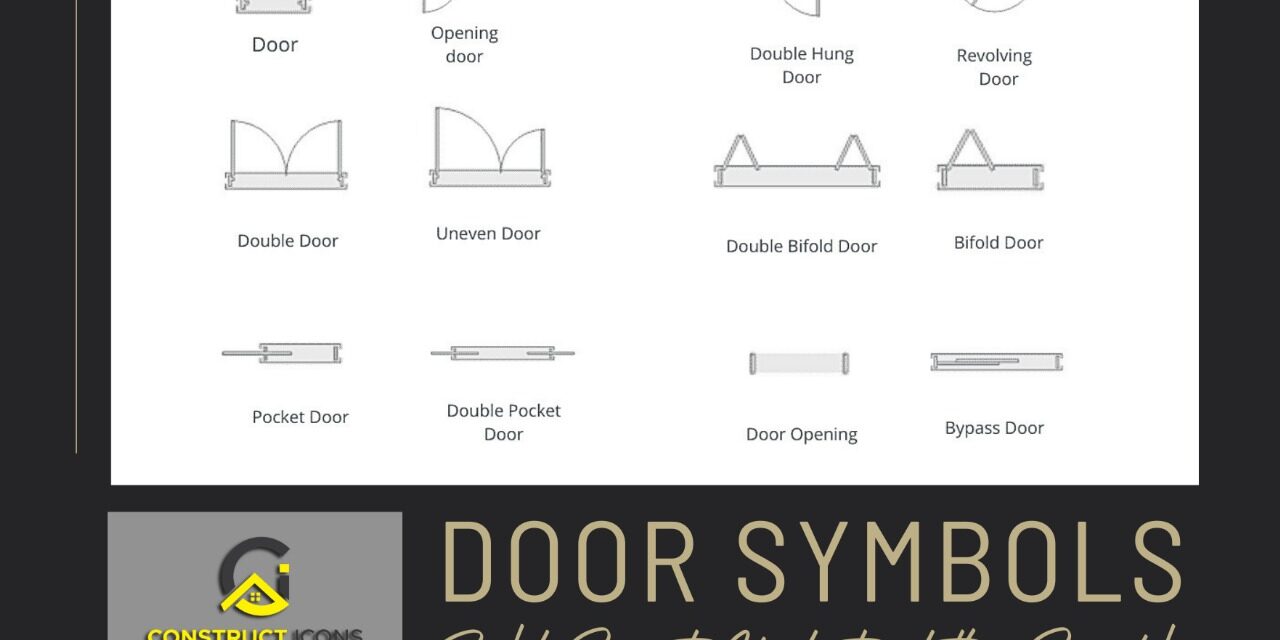
In architectural drawings, door symbols represent more than meets the eye. A curved arc indicates the swing direction, the orientation of the symbol indicates hinge placement, and specific markings denote whether a door is single, double, sliding, bifold, or pocket-style.
Every door type is depicted with a distinct graphic convention:
-
- Standard hinged door: Typically shown with a line (the door leaf) attached to a wall, with an arc illustrating the swing.
- Double doors: Two leaves with mirrored swing arcs.
- Sliding doors: Parallel lines within a wall cavity or rail path.
- Pocket doors: Lines disappearing into the wall to indicate hidden tracks.
- Bifold doors: Segmented lines that fold into one another.
- Revolving doors: Circular or semi-circular arrows or arcs.
These symbols provide critical information for both design intent and on-site construction, including space planning, furniture layout, and emergency egress compliance.
Why Are Door Symbols So Important?
While doors may seem like minor details compared to beams or foundations, they are central to how people move through a space, how rooms connect, and how private or public an area feels. When their symbols are misread or misunderstood, the consequences can be costly:
-
- Inadequate clearance for furniture or wheelchairs
- Incorrect installation of hardware and frames
- Inconvenient swing directions causing bottlenecks
- Visual inconsistency with architectural style
That’s why precision in interpretation matters.
At Construct Icons, we translate these intricate symbols into meaningful guidance, ensuring that every contractor, builder, and client knows not just where a door goes — but what kind of door it is, and why it was placed there.
Enhancing Spatial Awareness and Design Flow
Doors aren’t just transitions—they are architectural features that control flow, light, privacy, and accessibility. The right door placement can make a space feel open and inviting, while the wrong one can obstruct movement or clash with the intended use of a room.
Reading the symbol properly allows you to anticipate:
-
- Room functionality: Will a door block cabinetry or fixtures when opened?
- Privacy needs: Does a space call for a sliding barn door or a sealed solid-core panel?
- Aesthetic balance: Are the door types consistent with modern, classic, or industrial design themes?
Blueprints convey these decisions subtly, and it takes trained eyes to spot the story behind each arc, line, and symbol.
Empowering Clients Through Clear Interpretation
For many homeowners and commercial clients, architectural drawings can feel intimidating. Door symbols, though simple, often lead to confusion when clients try to visualize their space. At Construct Icons, we believe that clarity builds confidence.
We walk our clients through each plan, ensuring they understand:
-
- Where doors will go
- How they’ll open
- How the type affects usability
- What materials or aesthetics the symbol represents
This empowers our clients to make informed design choices, ask the right questions, and even imagine walking through their future space — long before the first brick is laid.
Making a Statement, One Door at a Time
Doors are often the first and last elements people interact with in a space. They set the tone for what’s beyond. A heavy wooden pivot door says “grand entrance.” A sleek glass slider says “modern and open.” A minimalist pocket door whispers “efficiency.”
At Construct Icons, we don’t just ensure your doors function — we make sure they speak. Every symbol we decode, every design detail we refine, is part of a greater mission: to bring your architectural vision to life, one line, one arc, and one opening at a time.
What’s Next in the Series?
In the next part of our Architectural Symbols series, we’ll take you into the world of window symbols — how they indicate light, air, and design elegance within architectural plans. Whether you’re an aspiring builder, a project owner, or a student of design, this series is your key to reading architecture like a pro.
Construct Icons: Because when we say “open doors,” we mean opening possibilities — through clarity, expertise, and construction intelligence.
At Construct Icons Pvt. Ltd., we’re committed to turning your vision into reality — with precision, expertise, and integrity.
📍 Office: House No. 9, Street 2-A, Block F, Naval Anchorage, Islamabad, ICT 45750
📞 Call Us: +92 300 959 0508 | +92 333 959 0508
📧 Email: info@construct-icons.com
🌐 Website: www.construct-icons.com
Let’s build something extraordinary — together.